The Mamertine Prison: The Final Captivity
The Mamertine Prison, historically known as the Tullianum or Carcer Mamertinus, holds a significant place in Catholic tradition as the reputed site of the final imprisonment of Saint Paul, often alongside Saint Peter, prior to his martyrdom. Located beneath the church of San Giuseppe dei Falegnami and overlooking the Roman Forum, the prison consists of two chambers, one above the other. The lower chamber, or Tullianum, was originally built as a cistern—a circular dungeon excavated from rock and built of tufa blocks. The conditions within this dungeon were notoriously harsh; the Roman historian Sallust described it as “repulsive and terrible on account of neglect, dampness, and smell.” Historically, famous enemies of Rome, such as King Jugurtha, were thrown into this lower dungeon to perish.
It is necessary to distinguish the Mamertine tradition from the imprisonments of Paul recorded in the New Testament. The Acts of the Apostles concludes with Paul’s first Roman imprisonment, describing a period of house arrest where he lived for two whole years in his own hired lodging and preached the Kingdom of God “without hindrance” (Acts 28:31). In contrast, the Mamertine Prison is associated with Paul’s second Roman imprisonment, which occurred under the Emperor Nero after Paul had reportedly traveled to Spain or Macedonia and returned to Rome. It was during this final captivity—about which Acts is silent—that Paul is believed to have been held in the Tullianum.
Ecclesiastical tradition asserts that while incarcerated here, the Apostles performed miracles. A legend claims that a fountain miraculously sprang up in the floor of the dungeon, allowing Paul and Peter to baptize their jailers, Saints Processus and Martinianus. While the Catholic Encyclopedia notes that these local commemorations are based on legends and that there is no reliable evidence explicitly placing the Apostles in the Tullianum, it concedes that it is “not impossible that Peter and Paul were actually confined in the chief prison in Rome at the fort of the Capitol, of which the present Carcer Mamertinus is a remnant.” The spiritual value of this site remains significant; Pope Francis has highlighted it as a place of prayer, noting that even in such terrible conditions, the Apostles “prayed and evangelized.”
The Martyrdom at Tre Fontane
The site of Saint Paul’s martyrdom is historically identified as Aquae Salviae, known today as Tre Fontane (Three Fountains). Located approximately two miles from his burial site, this location sits somewhat east of the Ostian Way (Via Ostiensis) near the Via Laurentina.
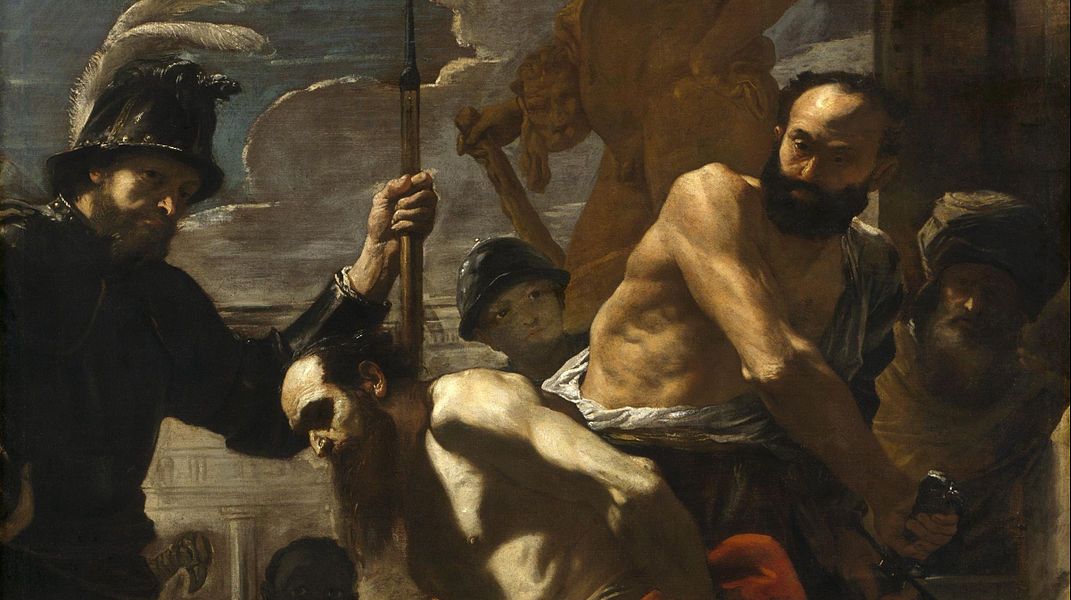
The modern name of the site derives from a persistent legend regarding the moment of Paul’s death. According to the apocryphal Acts of Peter and Paul (fifth century), Paul was condemned by Nero and led out of the city to Aquae Salviae, near a specific pine tree. Because he was a Roman citizen, he was sentenced to die by the sword (beheading) rather than crucifixion, the penalty suffered by Saint Peter. The legend states that when Paul was beheaded, his severed head rebounded three times on the ground, and a miraculous source of water sprang forth at each of the three spots where the head touched the earth. These fountains flow within the sanctuary to the present day.
The narrative of his martyrdom also includes the tradition of a one-eyed woman named Perpetua. The Acts recount that as Paul was being dragged to execution, Perpetua wept for him. Paul requested her handkerchief to bind his eyes, and despite the soldiers’ mockery, she gave it to him. After his beheading, the handkerchief was miraculously restored to her, stained with drops of blood; upon receiving it, her sight was fully restored.
Today, the Abbey of Saints Vincent and Anastasius occupies the site. The complex includes the Church of St. Paul of Three Fountains, raised over the specific spot of the beheading, containing the three springs and the pillar to which Paul was allegedly bound. While Pope Benedict XVI noted that the account of the rebounding head is “legendary,” the site remains a monument to Paul’s “extraordinary spiritual heritage.”
Distinction Between Death and Burial
It is historically important to distinguish the site of the Apostle’s martyrdom from the site of his burial. Paul was martyred at Aquae Salviae (Tre Fontane), but following his execution, his body was taken about two miles away to the “estate of Lucina,” a Christian matron, on the Ostian Way. This burial site is where the Emperor Constantine later built the first basilica, which was expanded into the present-day Basilica of Saint Paul Outside the Walls.